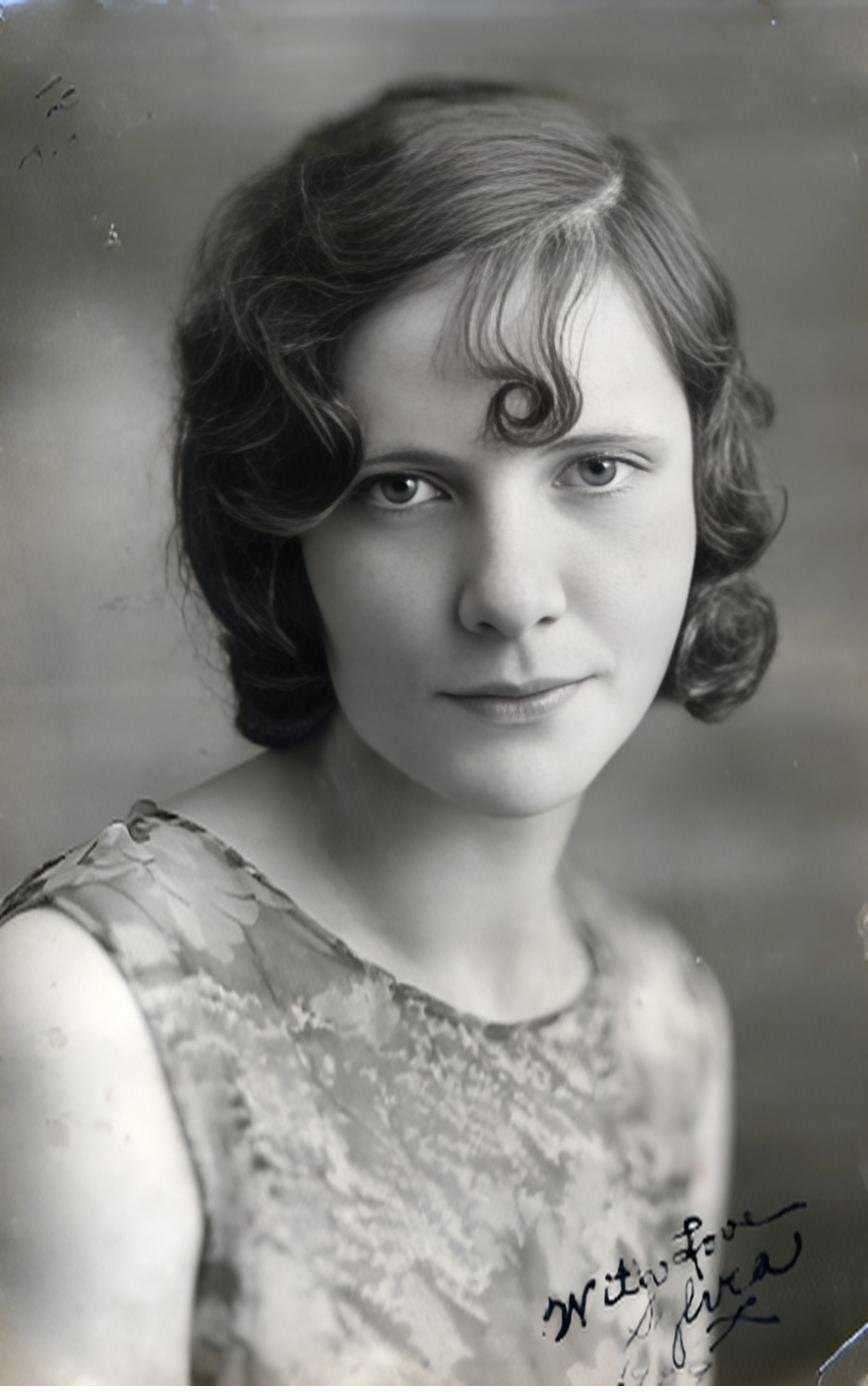
The Danish ancestry of our grandmother Sylvia Lena Larsen Andrusko
1746 – Present
Scroll to begin ↓
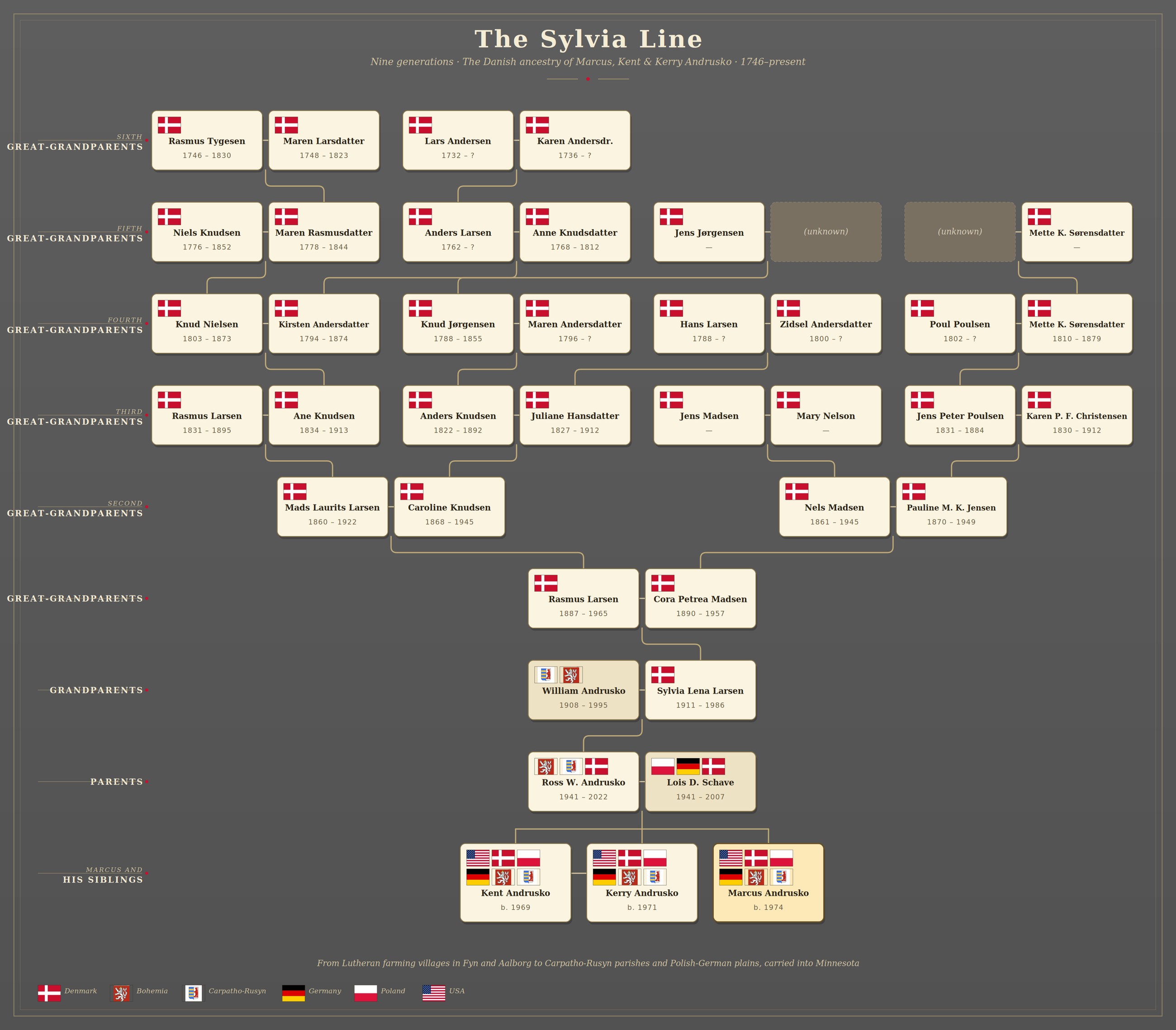
The Family at a Glance
Nine generations, from the Lutheran farming villages of Fyn and the Aalborg country down to Kent, Kerry, and Marcus. Drag to explore on a small screen.
Where We Came From
Two Corners of Denmark
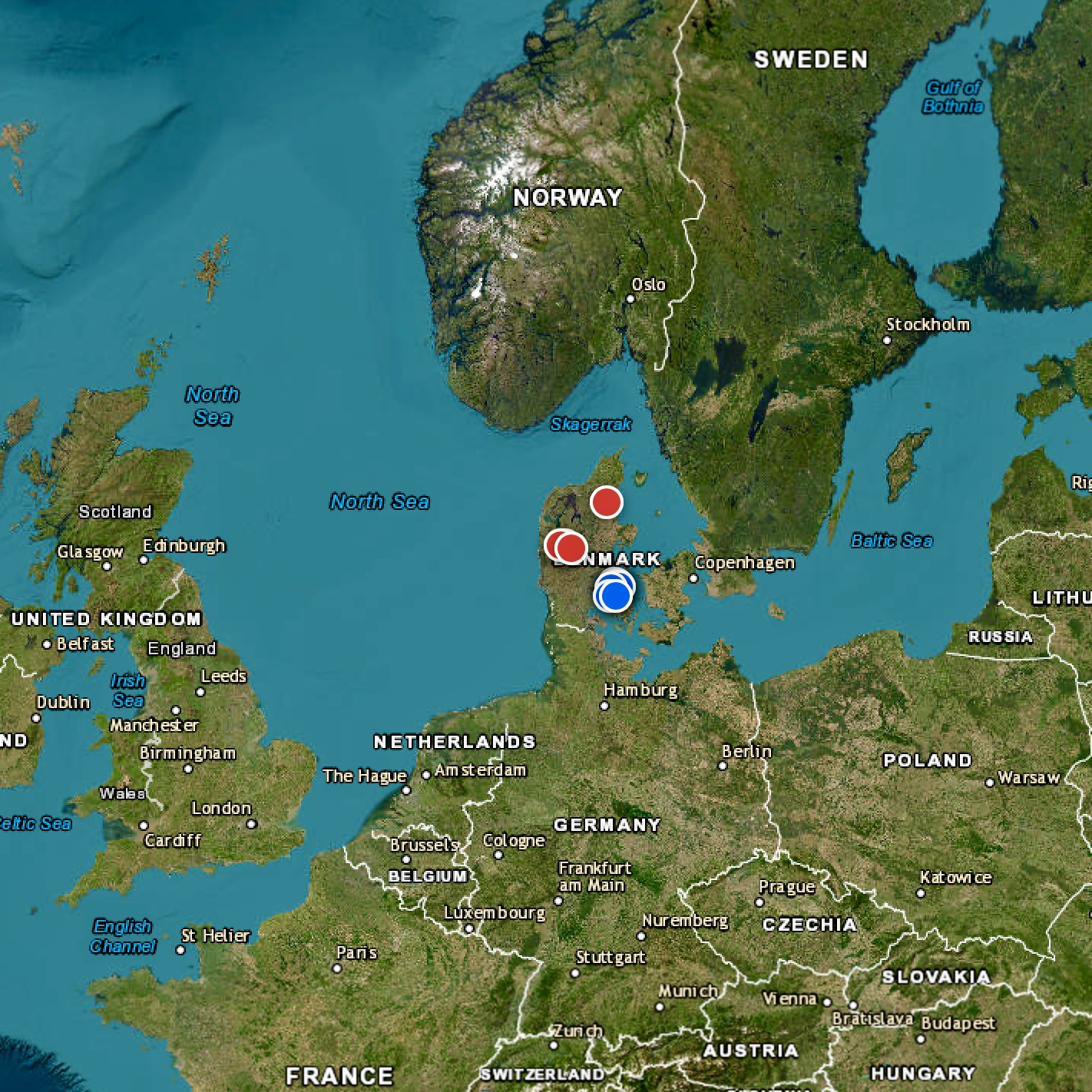
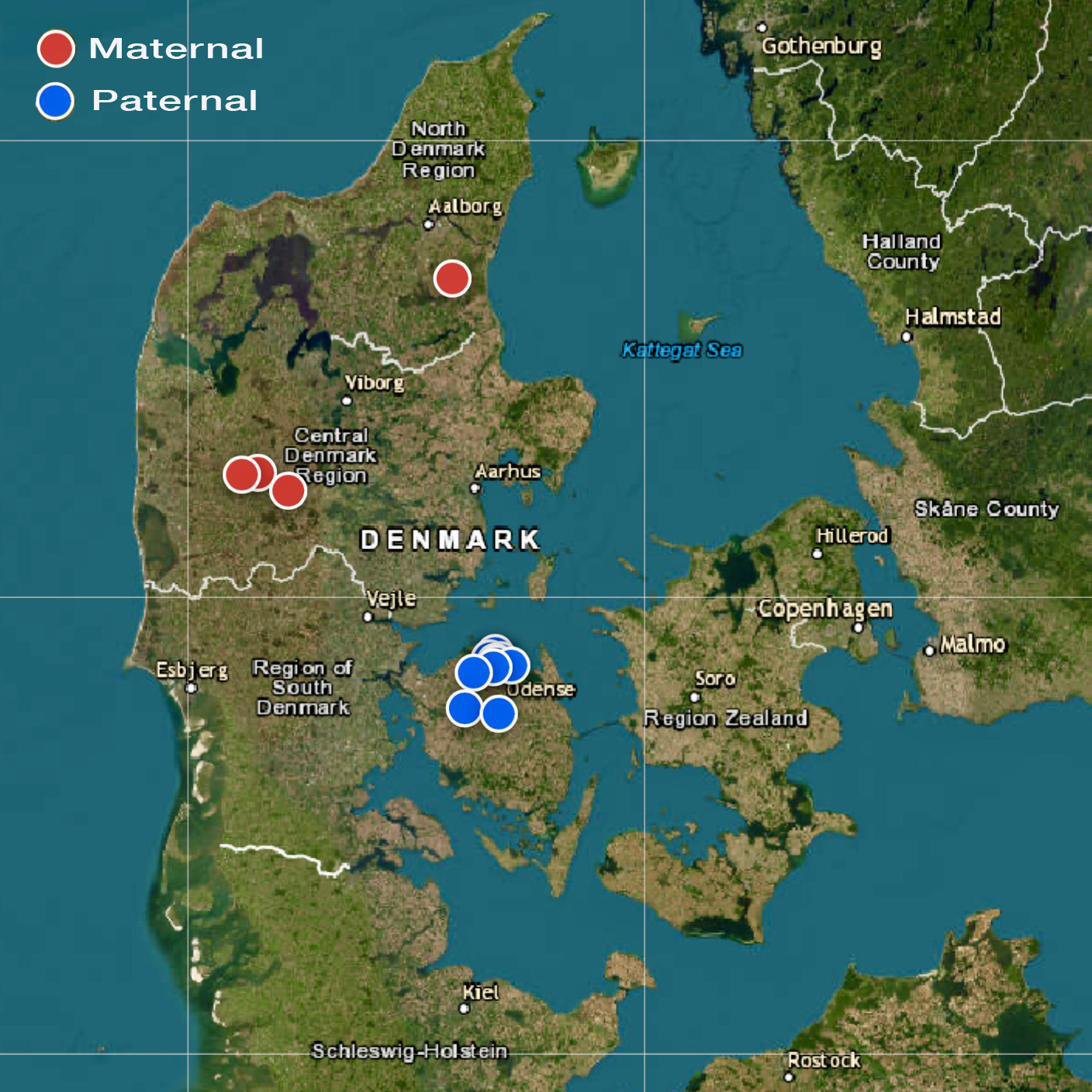
The two lines that met in Minnesota began two hundred miles apart, and had never known each other in the old country.
Two corners of one country. The paternal Larsens and Knudsens came from Fyn, near Odense. The maternal Jensens came from the Aalborg country in Jutland, two hundred miles north.Closer in. The two origins that first met across an ocean, in Minnesota.
Part One
The Old World
The Danish ancestry of Sylvia Larsen Andrusko, before emigration.
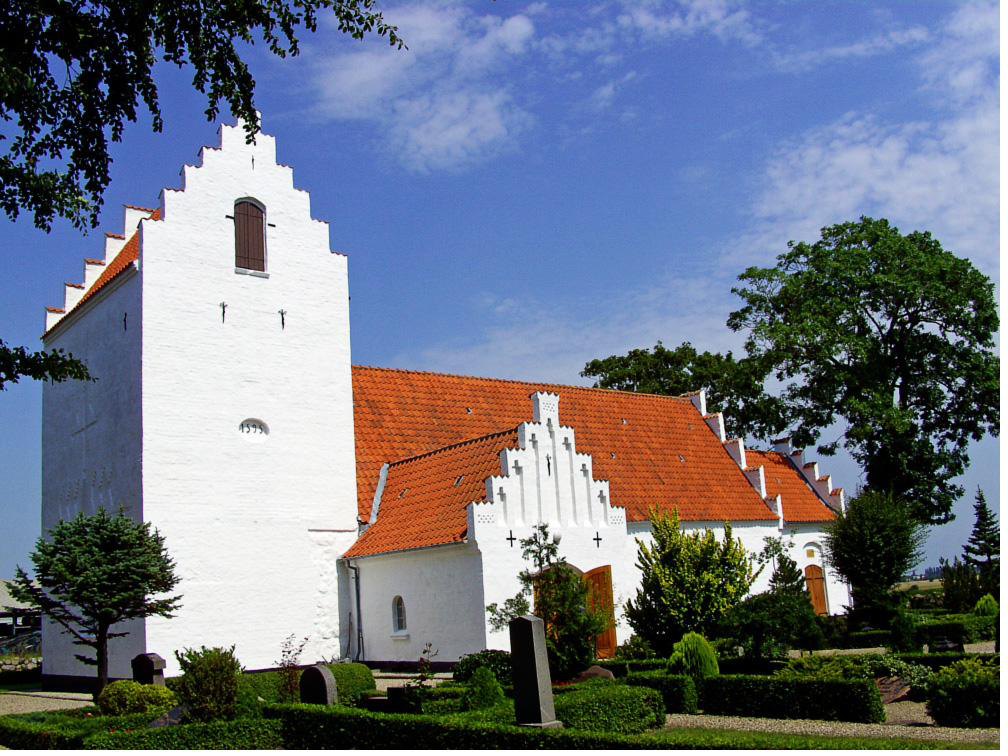
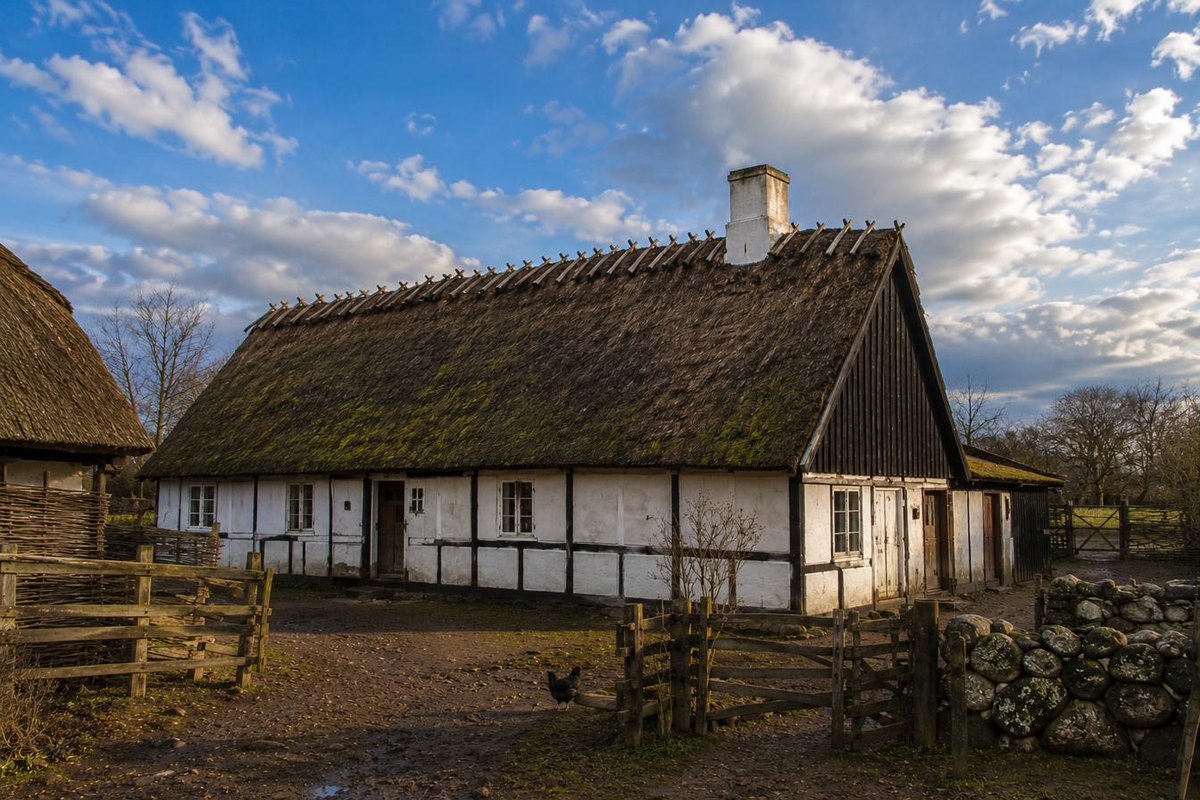
Skeby is a parish on the north coast of the Danish island of Fyn, ten miles north of the city of Odense. It is the kind of country that does not announce itself. Low, open ground, with the brackish water of the Odense Fjord just beyond the fields. Hedgerows running between strips of cultivated land. A handful of small farming hamlets strung along a coastal road: Hessum, Ølund, Baagø, Roby. Each was a cluster of roughly fifteen households around a road junction or a pond. The houses were timber-framed, whitewashed, thatched. The fields lay just beyond the houses. The parish boundary, usually a road or a stream, lay beyond the fields. The sky there is wide for such a small island, and the weather comes in off the sea.
There has been a Lutheran church at Skeby since at least the twelfth century. Skeby Kirke is small and Romanesque, with whitewashed walls and a tile roof. The oldest parts of the nave are the original twelfth-century stonework. The font in which babies were baptized was old when Hans Larsen was born, old when Mads Larsen was born, and still in use when their grandchildren were christened in it. Six generations of our father-line ancestors were baptized in that church.
Skeby Kirke. Six generations of our father-line ancestors were baptized at the font inside.
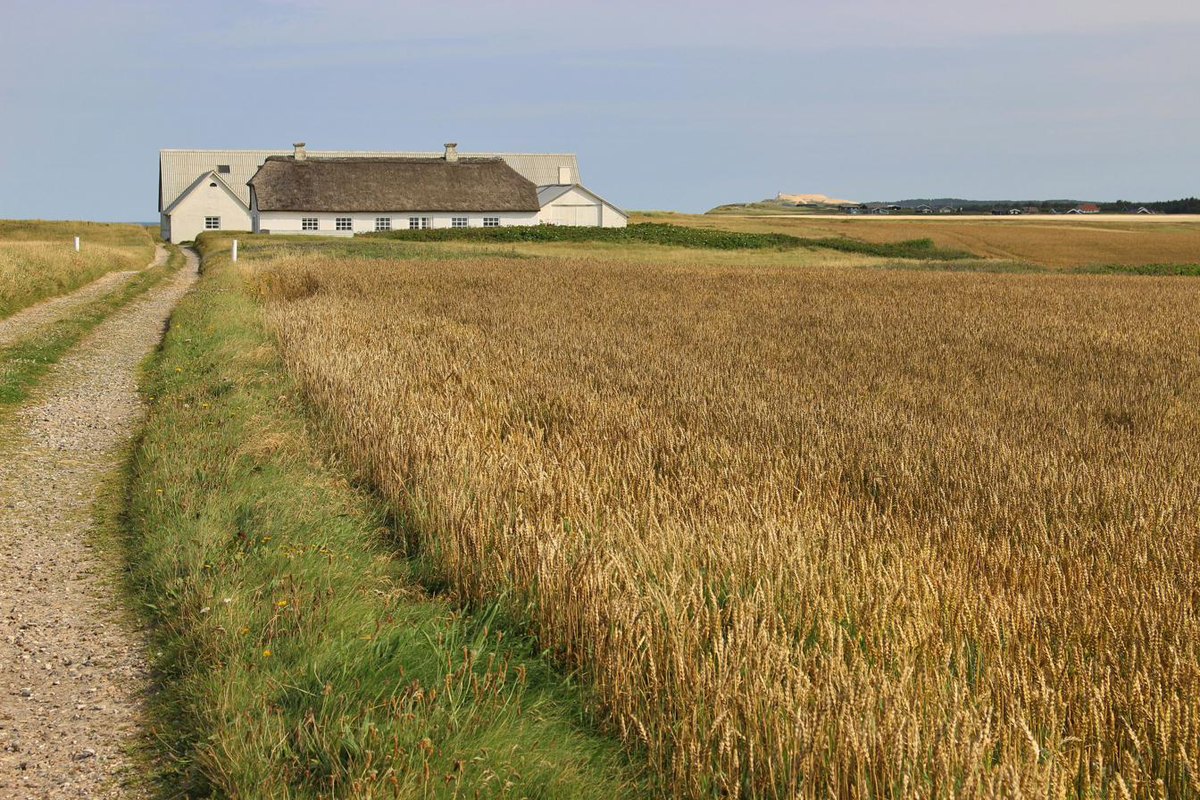
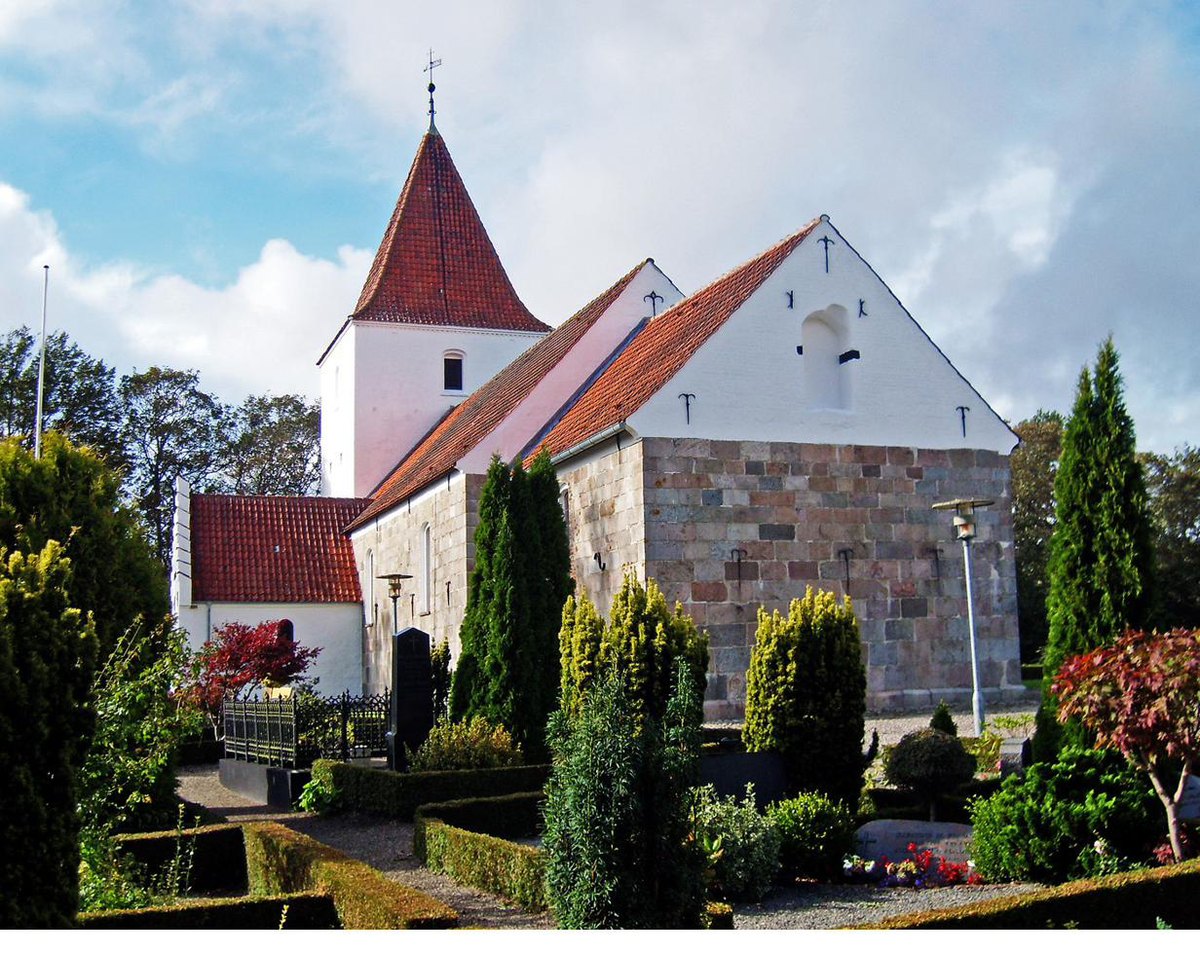
Two hundred miles to the northwest, in eastern Jutland, lies the other parish, called Skibsted. It sits in Aalborg County, in country that was still being broken from heath when the nineteenth century began. The Jutland heath was a harder kind of land than Fyn. Sandy soil. Heather in late summer, scrub the rest of the year. Big open horizons. Wind off the North Sea. Through the early nineteenth century, hamlet by hamlet and parish by parish, the heath was being drained and plowed and planted in grain. By the time our great-great-grandmother Pauline Mette Kirstine Jensen was born at Skibsted in 1870, the place was farming country, but it was younger farming country than Fyn, the soil thinner, the houses fewer.
The Jutland heath country. Younger, harder farming land than Fyn, broken from heath through the nineteenth century.
Skibsted Kirke. The Jutland parish church of our mother-line ancestors, where Pauline Jensen was baptized.
Sylvia Lena Larsen was born on a Minnesota farm in May of 1911. Her father came from Skeby. Her mother was the daughter of immigrants from Skibsted. By the time she was born, both sides of the family had crossed the Atlantic. The two lines that reached her had not known each other in Denmark. They met for the first time at a wedding in Jackson County, Minnesota, in September of 1909.
Class
Danish village life in those parishes was tiered. At the top, the Gårdmand, the small landowning farmers. A gaard was a working farm, a house and outbuildings and fields, with enough land to feed a household and keep two or three live-in servants. About a third of rural Danes were in this class. They were not wealthy people, but they had a roof of their own and a piece of land and a place at the parish church among the respected families.
Below them, the Husmand, the cottagers. A husmand had a small house and a garden but not enough land to live on. He worked for wages on his neighbors’ farms.
Below both, the landless: laborers, the elderly poor, and those on parish alms, the Almisselemmer, who had run out of everything else.
Our people came up through all three of these tiers, and back down through some of them.
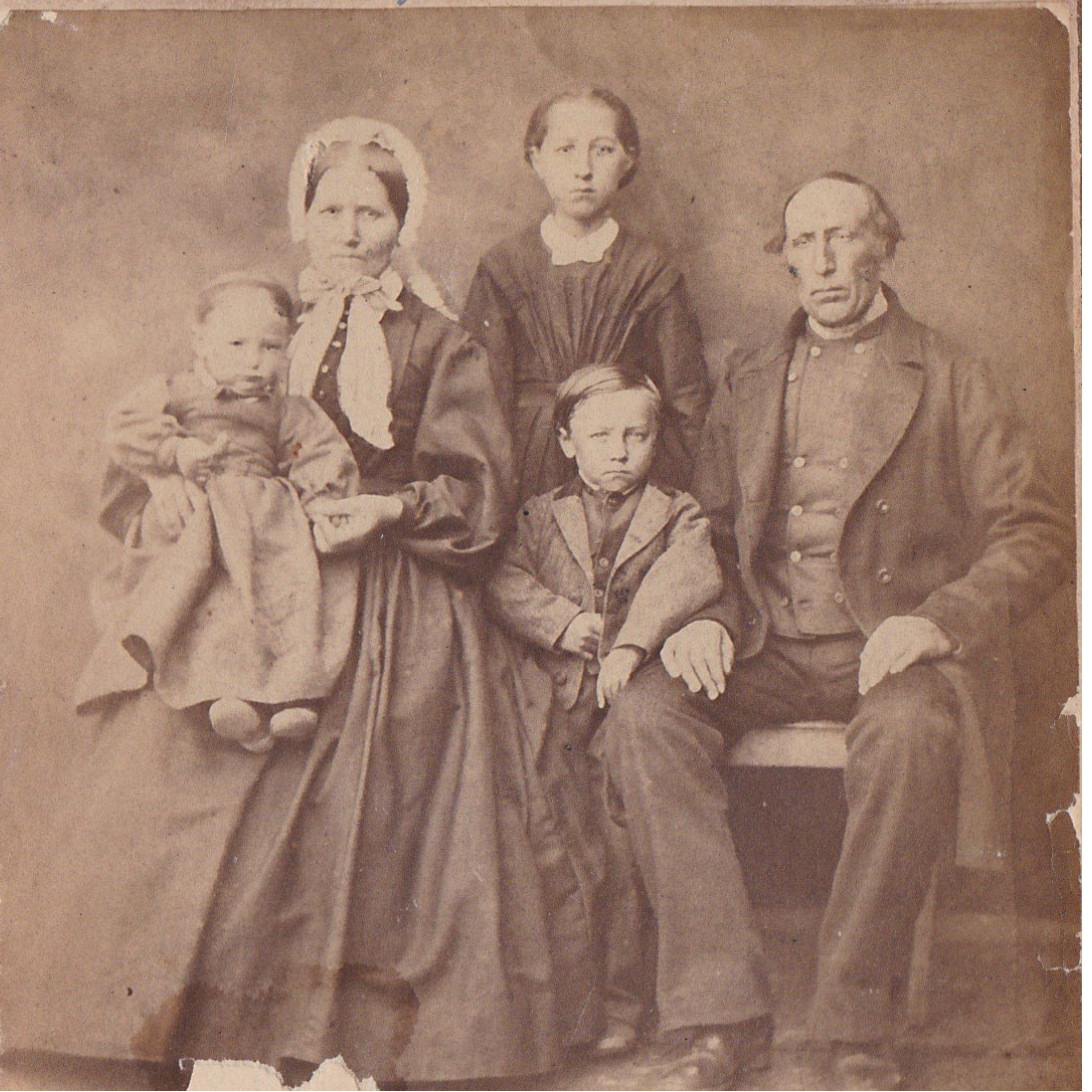
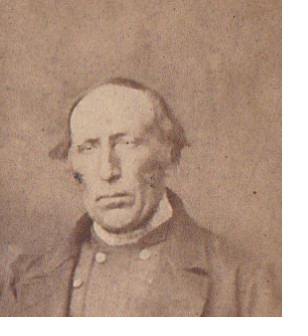
Our fourth-great-grandfather Hans Larsen turns up in the 1834 Danish census at Baagø, in Skeby parish, listed simply as a fattig husmand, poor cottager. The census-taker did not soften it. The same census shows a neighbor of his, our fourth-great-grandfather on a separate branch, Knud Nielsen, also a husmand. Knud would later climb a rung to bolsmand, smallholder, the step between husmand and gårdmand. But in 1834 he was still in the cottager tier with Hans.
The Knudsen family of Skeby. Anders Knudsen at right, Juliane Hansdatter at left holding a small child. Anders rose to gaardmand in the 1850s.
The next generation did better. Hans’s daughter Juliane Hansdatter married Anders Knudsen, the son of a different family up the road. Anders, our third-great-grandfather, became a gårdmand at Skeby village in the 1850s. The line had moved up.
It did not stay up everywhere. Our fourth-great-grandmother Maren Andersdatter, who had been a gårdmand’s wife at Hessum for most of her life, ended her days on the parish poor list at the next parish over, Tommerup, as an almisselem. Whatever the family had had, she was without it in the end.
That was how it worked. Families went up the village ladder, and families went down. Sometimes the same family did both, in the same generation, on opposite branches.
Names, baptism, and the parish minister
Most Danes in this period did not carry fixed surnames. They carried patronymics, a father’s first name plus a suffix. A son of Lars was Larsen. A daughter of Hans was Hansdatter. The name changed every generation. Hans Larsen’s eldest son was Anders Hansen. Anders’s son would have been Andersen. It was a way of saying whose son or daughter you were, every time someone said your name.
Names within a family also followed a pattern. A first son usually took his paternal grandfather’s name. A first daughter took her maternal grandmother’s. When a child died young, the next child of the same sex was often given the same name. The name went on, even if the first child carrying it had not.
Anders Knudsen. Our third-great-grandfather, who climbed from the cottager tier to a Skeby village farm.
The Knudsens kept that pattern. Their daughter Caroline was born in December of 1862. She died at two years, four months and was buried in the parish churchyard at Skeby in April of 1865. Her parents named the next daughter Karoline as well, born in July of 1868. The second Karoline grew up and married Mads Larsen. She is our great-great-grandmother. The first Caroline is in the parish register and the churchyard, and her name is the name our great-great-grandmother carried.
Hans Larsen had done a similar thing a generation earlier. His second son, born in 1831, was Lars Hansen, almost certainly named for Hans’s own father. The grandfather’s name went forward two generations.
The Lutheran Folkekirken, the People’s Church, ran through everything. Every household in Denmark was Lutheran by law. The parish minister was the religious authority and the civic record-keeper at the same time. He read royal announcements from the pulpit on Sunday morning. He certified births and deaths to the state. He officiated at weddings, baptisms, and burials. The leather-bound register he kept in the church safe was the village’s continuous memory, going back through fathers and grandfathers and great-grandfathers in the same hamlets.
Sometimes the register opens onto something more particular. Our third-great-grandmother Juliane Hansdatter was home-baptized the day after her birth, on the 28th of November 1827. Home baptism within a day of birth was the parish minister’s response to a worry that the baby would not last the night. Whatever the danger was, fever or weakness or the cold of late November on the north coast of Fyn, Juliane survived it. The formal baptism was performed at Skeby Kirke six weeks later, the family well enough by then to bring her in. The margin of the register carried the names of the godparents. One of them was Knud Nielsen of Baagø, a neighbor at the time. His daughter Ane would later marry into the Larsen line and become Mads’s mother. The village was small. The same names kept turning up.
The household and the year
By the time of the 1890 Danish census, our great-great-grandfather Mads Laurits Larsen had a gårdmand’s farm at Skeby. He was thirty when the census-taker came through. His wife Caroline was twenty-two. They had two young sons by then, and Caroline’s widowed mother Juliane, sixty-two, lived under their roof.
The year on a farm like Mads’s ran on a fixed cycle. Plowing in spring. Sowing in May. Haying in midsummer. Harvest in late summer. Threshing through the autumn. Slaughter in November. The crops were the small grains of northern Europe: rye for bread, oats and barley for fodder and porridge, and potatoes, which had become a household staple in the nineteenth century. Cattle gave milk and beef. Pigs gave winter meat. Geese and chickens gave eggs and feathers. A gårdmand’s farm fed most of its own household. What it did not grow, it bought at the parish market or the Odense Fair, paid for by the cash from surplus grain.
A Fyn farmhouse. Timber-framed, whitewashed, thatched, of the kind our people lived in. House, garden, and outbuildings around a packed-earth yard.
Inside the house, the women ran everything that was not in the fields. The dairy. The cooking. The spinning. The laundering. The raising of children. The nursing of the sick. They attended one another’s births. Childbirth was where Danish women of this period most often died. The Skeby death register, in any given year of the 1860s, would carry several women lost in or just after it.
Children worked as soon as they could carry water. At fourteen they were confirmed at the parish church and sent out to service. Boys went as Karle, farm laborers. Girls went as Piger, maidservants. In Mads’s own 1890 household, his fifteen-year-old brother Lars was registered as a Tjende, a live-in servant under his older brother’s roof. The labor that ran the farm was extended-family labor as much as it was nuclear-family labor.
There was a particular Danish arrangement called Aftægt. When a farmer got too old to work his land, he handed it to a son or a son-in-law, and in return he received room, board, fuel, and a small annual allowance for the rest of his life. The Aftægtskone, the retired family elder, usually a widow, became a permanent fixture in the household. In Mads’s 1890 census, his mother-in-law Juliane was the aftægtskone. Ten years later she was still in the same household, though by then the household had crossed the Atlantic and was on a rented farm in Elm Creek Township, Martin County, Minnesota. The American census-taker, not having a word for aftægtskone, wrote her down as mother-in-law.
The forces from outside
There were big forces always pressing on these parishes, even from far away.
In 1788 the Danish crown lifted the Stavnsbåndet, the law that had bound peasant men between fourteen and thirty-six to the parish of their birth since 1733. After 1788 a young man could move. Through the 1790s and into the early 1800s, agricultural reforms broke up the open-field village system that had run Danish farming since the Middle Ages. The shared strips of village land were consolidated into separate small farms. Cottages drifted out of the village clusters to the edges of fields. The reforms helped the gårdmand class. They did not help the husmænd.
Then came the wars. Denmark sided with Napoleon’s France in 1807. That September the British fleet bombarded Copenhagen and took the Danish navy. In 1813 the Danish state went bankrupt and the currency collapsed to a tenth of its old value. In 1814 Denmark lost Norway to Sweden. None of this reached Skeby or Skibsted as direct violence, but all of it reached as taxes and prices and pressure. Then in 1816 the harvest failed across northern Europe, after a volcano on the other side of the world (Indonesia) had erupted the year before and cooled the climate. Hans Larsen was about twenty-seven that year. Maren Andersdatter was about twenty. The young adults of our earliest-known generation lived through what was, by some reckonings, the hardest year in nineteenth-century Europe.
By the middle of the century the Danish countryside carried more people than the land could support. Younger sons could not inherit. Then in the 1870s the European grain market collapsed when American wheat reached the ports cheaply. The husmænd, who had the least to lose, started leaving first. The Gårdmand, who had to sell their land before they could go, left later.
News came back the other way. Letters from settlements in Iowa and Wisconsin and southern Minnesota reached Danish parishes. American Lutheran church associations sent pastors back to Denmark to recruit. Steamship lines from Copenhagen advertised passage to New York at prices a working family could save toward. By 1880 a Danish family of two adults and three children could reach Minnesota for about what a Skeby gårdmand’s small farm was worth. America was not an idea anymore. It was a place somebody’s cousin had gone.
Our people did not go all at once. The Jensens of Skibsted went first, reaching Nebraska before 1884. The Larsens and Knudsens of Skeby followed in 1895, after the death of our third-great-grandfather Rasmus Larsen the elder, the gårdmand at Ølund, in March of that year put the family farm out of his son’s reach. By the turn of the new century, the children who would once have been baptized at Skeby Kirke were being baptized in the new Lutheran churches of southern Minnesota.
Part Two
Crossing
From Denmark to southern Minnesota.
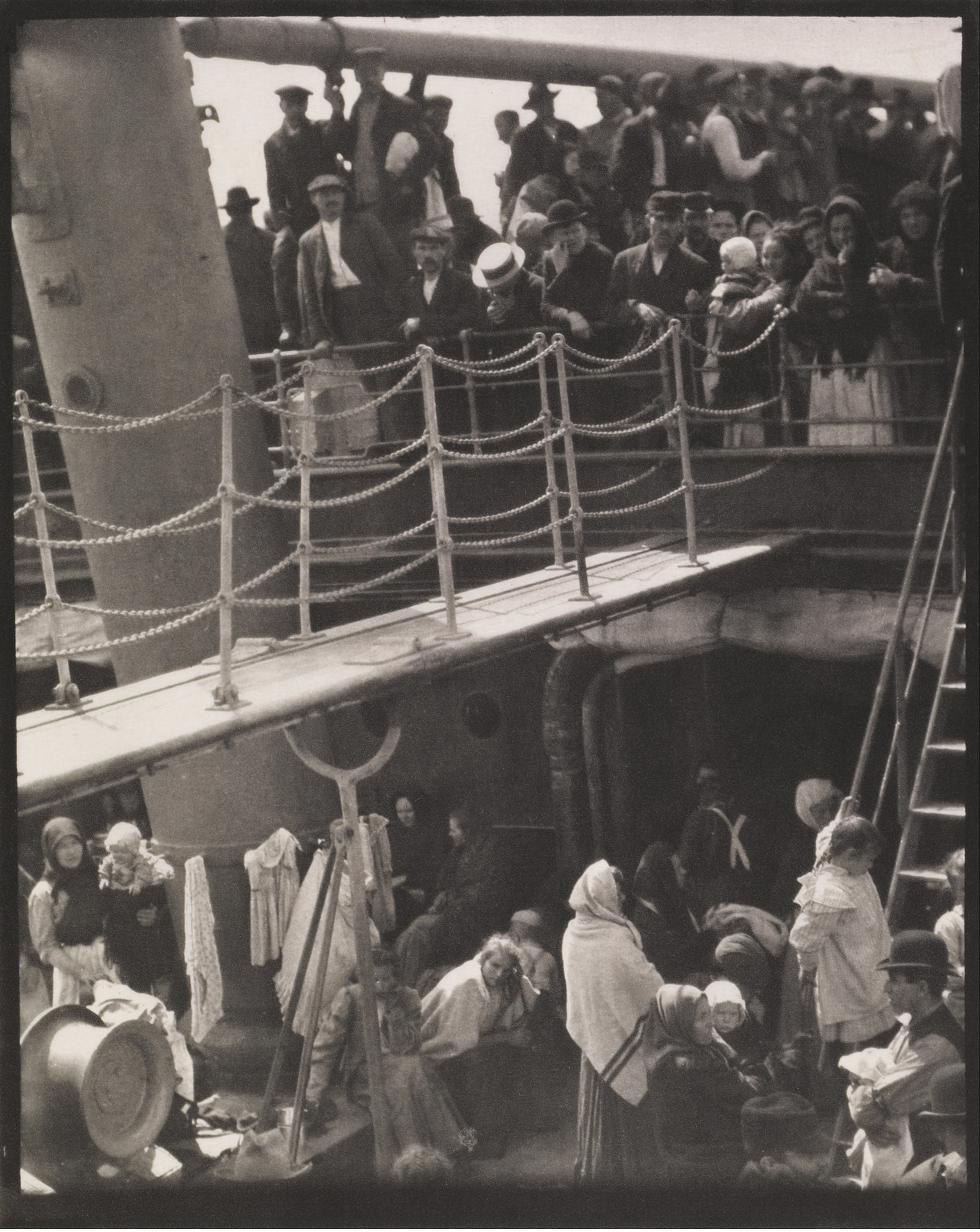
The Atlantic in those years was about ten days of rough water in the cheap class. They called it steerage. Four or six to a berth, in compartments below the waterline, with no portholes and the noise of the engines coming through the hull. The food was bad. The light was thin. The big ships of the Thingvalla Line out of Copenhagen, and the rival German lines out of Hamburg and Bremen, carried Danish families to America by the thousand through the 1880s and 1890s. Our people were among them.
Steerage. A period photograph of the steerage deck, not our family, but the passage they bought looked much like this. (Alfred Stieglitz, 1907.)
For our third-great-grandparents Jens Peter Jensen and Karen Christensen Poulsen at Skibsted, the push was that the husmand world they were in had no future for their children. For Mads Laurits Larsen at Skeby, it was that the Ølund gårdmand farm could not be divided five ways among him and his four brothers, and everybody knew it. The Madsens and the Jensens left first.
The Jutland crossing
Sometime in the early 1880s the Jensen family boarded a steamship at Copenhagen. What is known is that by 1880 they had moved a few miles south of Skibsted to a parish called Vebbestrup, where Jens Peter and Karen were getting by in a husmand household. By 1884 they were in Washington County, Nebraska.
The party was the four of them and Pauline. Jens Peter and Karen, husband and wife, both in their early fifties. Their two grown sons, Peder Christian and Hans Christian, in their twenties. And their daughter Pauline, our great-great-grandmother, then about ten years old.
Washington County sits on the Missouri River just north of Omaha. The country there is rolling farmland, more open and more lush than what they had left in Jutland. The prairie soil was deep and black and had been broken to grain only a generation before the Jensens arrived. Oak and hickory stood in the river bottoms and along the creeks. The county seat was at Blair, on the bluffs above the Missouri. The smaller settlements scattered across the rest of the county were post-office towns of a few hundred people each, with a Lutheran church, a grain elevator, a general store, a school. In many of those towns, Danish was what people spoke at home.
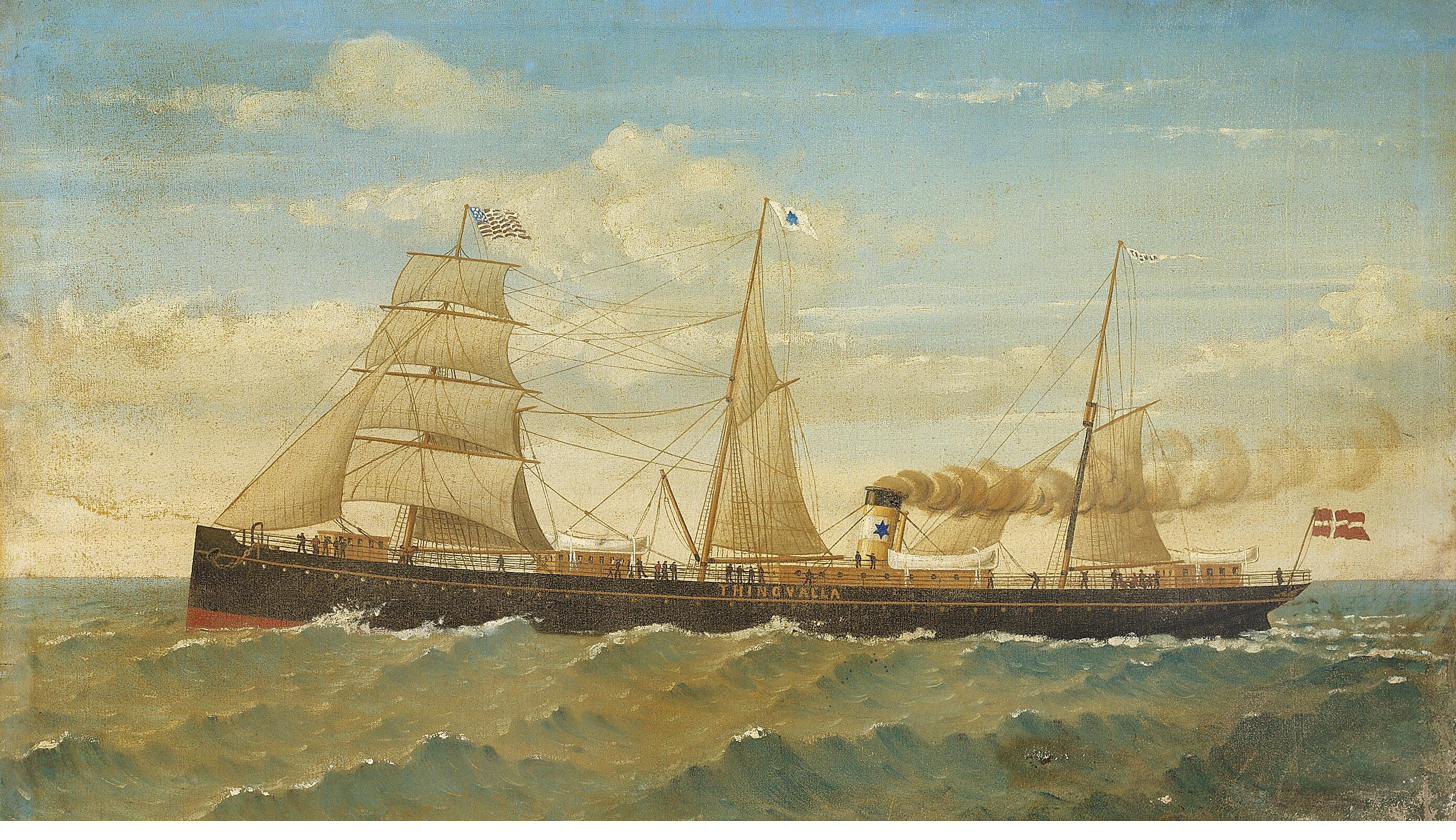
The Thingvalla line. The Danish-run steamships that carried our families from Copenhagen to New York in the 1880s and 1890s.
The crossing cost them early. In July of 1884, at the small Nebraska town of Orum, Jens Peter died. He was fifty-three. Nobody knows what took him. Pauline was thirteen. Her mother Karen was a widow at fifty-four. They stayed in Nebraska.
Three years after her father died, in May of 1887, at the county seat of Blair, Pauline married a Danish-born man named Nels Madsen. He was nine years older than she was. He had come over separately in 1881 and was farming nearby. Their first daughter Bertha was born in February of 1888. Their second, our great-grandmother Cora Petrea Madsen, was born in January of 1890.
Sometime between 1890 and 1892, the Madsens moved north into Minnesota. By 1900 they were settled on a farm at Petersburg Township in Jackson County, in the southwestern corner of the state. Eight more children would be born in that house over the next twenty years. Karen, Pauline’s widowed mother, came along and stayed with them for the rest of her life.
There is a photograph from those Nebraska years. A Danish-born photographer in or near Blair set up a studio shot of the family sometime in the late 1880s or early 1890s. Seven people sat for it. Karen at the right end of the seated row, in widow’s dress. Nels at the left end, with the toddler Bertha at his knee. The two Jensen brothers, Peder Christian and Hans Christian, standing behind the others. A young woman in the middle of the row, probably one of the brothers’ wives, though nobody is certain. And Cora, small and near her grandmother. It is the only known photograph of Cora as a child.
The Fyn crossing
The Larsens left in the autumn of 1895. The reason was the death back at Skeby six months earlier. Rasmus the elder, the gårdmand at Ølund, had died there on the 24th of March. He was sixty-four. The probate record from the months after his death is in a Danish archive somewhere, still unfound. Whatever it says, the farm was no longer Mads’s, and within six months his family had begun to leave. He fell from gårdmand to peasant with his father’s death.
The party that boarded the steamship at Copenhagen in the fall of 1895 was Mads and his wife Caroline and the three youngest of their five sons. Mads was about thirty-five. Caroline was twenty-six or twenty-seven. Laurits was four and a half. Knude was three. The infant Jørgen was ten months old. Caroline’s mother Juliane Hansdatter, sixty-seven, came along with them. The whole party was bound for Sherburn, Minnesota.
Two of the children did not get on the boat.
Anders Christian was nine. Rasmus, our great-grandfather, was eight. They stayed in Denmark. The why is not certain. Perhaps they stayed with grandparents in Skeby. Maybe because the family could not pay for all seven steerage tickets. Possibly because they were judged old enough to be useful as farm labor at home, while their parents found their feet in Minnesota. Nobody knows. What is known is that for three years, Caroline and Mads did not see their two oldest boys.
The reunion came in November of 1898. The two boys boarded the SS Thingvalla at Copenhagen, without adults caring for them. Anders was eleven by then. Rasmus was ten. The Thingvalla was the flagship of the Thingvalla Line, the Danish company that had been carrying emigrants since 1880. By the time those two boys got on her she had crossed the Atlantic many times. The manifest noted their destination: “to our father M. L. Larsen, Sherburne, Minn.” The ship reached New York on the twenty-eighth of November. From there the boys went west by rail. What an eleven-year-old and a ten-year-old saw on that train ride, nobody wrote down. What they walked into at Sherburn, after three years apart from their parents, nobody wrote down either. By 1900 the seven of them were together at Elm Creek Township in Martin County, on a rented farm.
The move had cost Mads his place in the class system. In 1890, back in Skeby, the Danish census-taker had written him down as Husfader Gaardmand: head of household, small landowner. By 1900 in Minnesota he was a tenant on someone else’s land. It took him fifteen years in America to get back to ownership. The 1910 census in Enterprise Township, Jackson County, listed him as the owner of his farm. He was fifty by then.
Why Minnesota
Sherburne, modern Sherburn, was a small town in Martin County, in the part of southern Minnesota the Danes had picked out. The country there was rolling prairie broken by a constellation of small glacial lakes, with woods along the shores and broad open farmland between. Danish immigrants had been arriving for twenty years by the time the Larsens got there. Danish-language Lutheran congregations had been founded. Whole townships were Danish-speaking. The chain pulled new arrivals to the same places, and new arrivals took in the next ones. The Larsens at Elm Creek took in a Danish-born boarder named Peter Larson. Danish was the language of the kitchen and the milking shed. English was the language of the school down the road.
Petersburg Township, where the Madsens had settled, was about eighty miles west of Sherburn, in Jackson County. Another heavily Scandinavian-Lutheran farming district. The two settlements were close enough that the next generation of Madsens and Larsens would meet and marry across the county line.
What was lost, what kept going
Some of what was lost did not get written down. The three-year separation of those two small boys from their parents. Jens Peter’s death in a Nebraska town his family barely knew. Six generations of Skeby gårdmand farming at Ølund, ended. Danish names anglicized by American clerks. Danish carried in the kitchen and the parlor, but not into the new schools.
What kept going was the shape of the life. There was still a farm. There was still a Lutheran congregation. There was still a school. The farm was rented instead of inherited. The Lutheran services were in Danish at first, then in English. The school was in English from the start. Within a generation, the children of these immigrants spoke Danish only at home.
By 1900 the two Danish families were both in place. The Larsens at Elm Creek, with seven family members under one roof. The Madsens at Petersburg, with old Karen still in their house. In September of 1909, the two families would meet for the first time at a wedding.
Part Three
Becoming the Family We Know
From a Jackson County wedding in 1909 to the family plot at Lakewood.
A Jackson County wedding
Our great-grandparents Rasmus Larsen and Cora Petrea Madsen were married on the first of September, 1909, at Petersburg Township in Jackson County, Minnesota. He was twenty-two. He had been born at Atterup in Skeby parish on Fyn, had crossed the Atlantic alone with his older brother at the age of ten, and had been on Minnesota farms with his family for the eleven years since. She was nineteen. She had been born at Blair, Nebraska, to Danish immigrants who had moved up to Petersburg before she was old enough to remember Nebraska. After that day, what had been two Danish family lines was one.
Cora, Sylvia, Bill, and Rasmus. Our great-grandparents with Sylvia and her son Bill. The two Danish lines became one at the Jackson County wedding in 1909.
The young farmers
Seven months after the wedding, the census-taker found them on a rented farm at Jay Township in Martin County. Rasmus was working it; the census record called him a general farmer. Cora was at home; the document called her wife. They had no children yet. Rasmus’s seventeen-year-old brother Knute lived with them as a hired hand. The Danish younger-brother arrangement had crossed the Atlantic and was running in rural Minnesota much as it would have run in Skeby.
Sylvia was born on the seventeenth of May, 1911, at Sherburn, the small Martin County town five miles east of the Jackson County line. She was baptized there five weeks later, on the twenty-first of June. Two years after her, her brother Leslie Alvin was born, in the town of Jackson. Two more children would follow at Barnesville: Fern Grace in October of 1920, Vera Lela in February of 1923. Sylvia was the oldest of the four. The first daughter. The one who would carry the farm years longest.
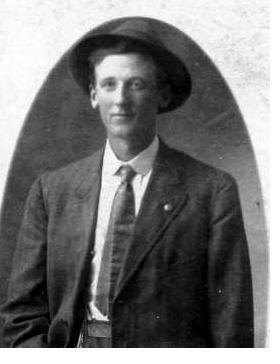
Rasmus Larsen. Sylvia’s father, our great-grandfather, who farmed in Jackson County and then the Red River Valley.
The Barnesville farm
Somewhere between Leslie’s birth in 1913 and the summer of 1917, the family moved a hundred and seventy miles north. From southern Minnesota up to Alliance Township in Clay County, near the small Red River Valley town of Barnesville.
The Red River Valley runs along the Minnesota and North Dakota border. The land there is the old bed of Lake Agassiz, a glacial lake that drained away thousands of years ago and left behind some of the deepest and richest soil in North America. The country is flat. The fields run to the horizon. The wind moves through them without much to slow it down. By the 1910s the valley was wheat country, with oats and barley and dairy alongside.
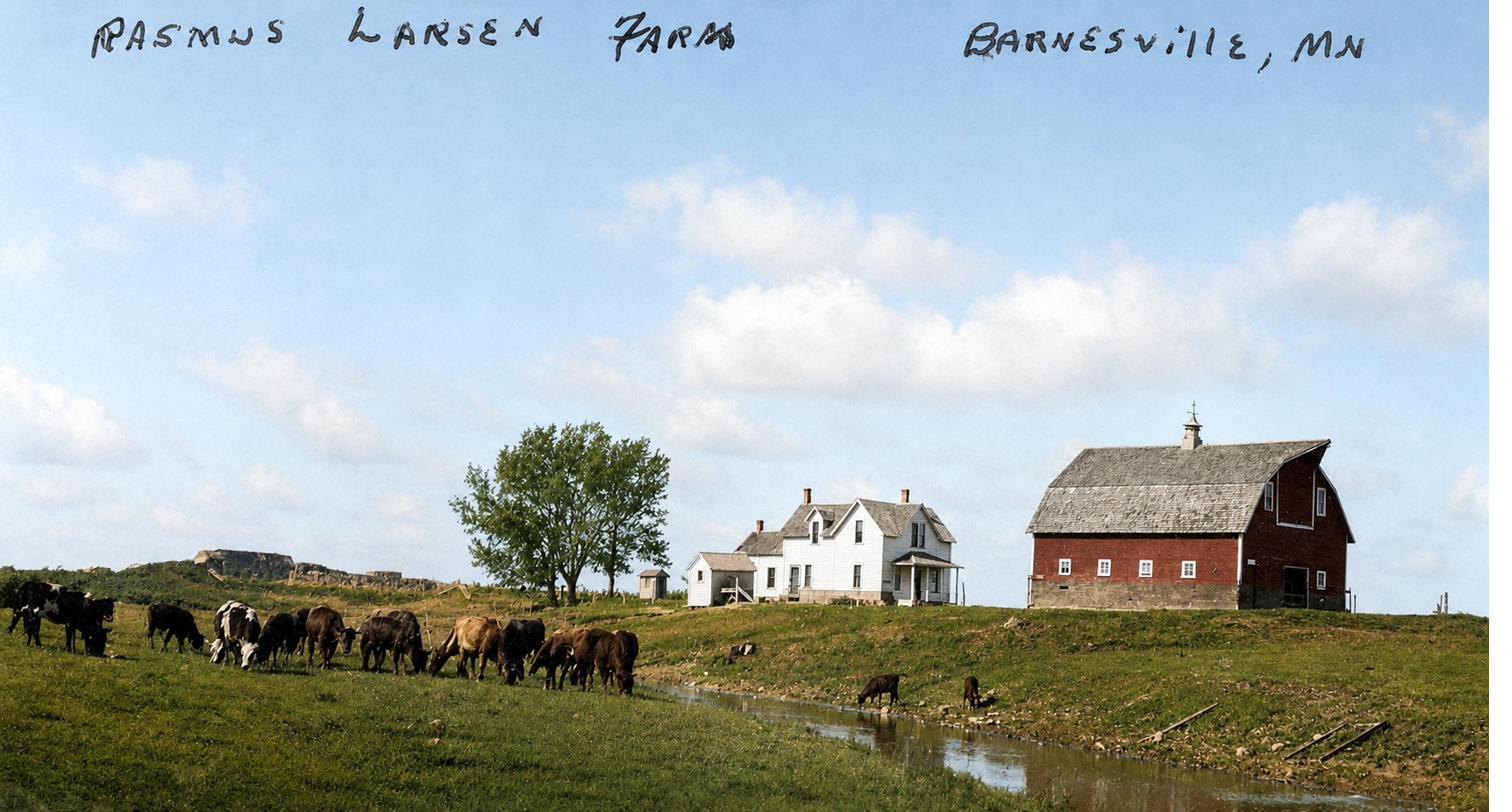
The Barnesville farm. The Red River Valley land the family worked through the 1910s and 1920s, where Sylvia grew up.
Rasmus signed his World War One draft card in June of 1917, at the Moorhead local board. He was thirty by then. The registrar described him: medium build, medium height, blue eyes, light brown hair, slightly bald. He had a wife and two children dependent on him, and his own farm at Alliance Precinct.
By 1920 the family was on a farm Rasmus owned, mortgaged but his own. He was thirty-two. The census-taker called him a farmer-employer. Cora was twenty-nine. Sylvia was eight. Leslie was six. A hired man named Earl Block, twenty-three, North Dakota born, lived in the household.
They farmed Alliance Township for about thirteen years. There is a photograph of the place, hand-labeled by Bill Andrusko years later. A two-story white-frame farmhouse with a shed-roof front porch, on a low rise. A red gambrel-roofed barn to the right, with a small cupola and four windows on the visible side. Cattle grazing along a slough at the bottom of the hill.
This was the house Sylvia grew up in. From her sixth year through her late teens she did farm-girl work all the way through. Carrying water and feed. Helping in the kitchen and the dairy. Helping with her two younger sisters Fern and Vera as they came along, both born in that house. The work made her physically strong, and the strength stayed with her the rest of her life.
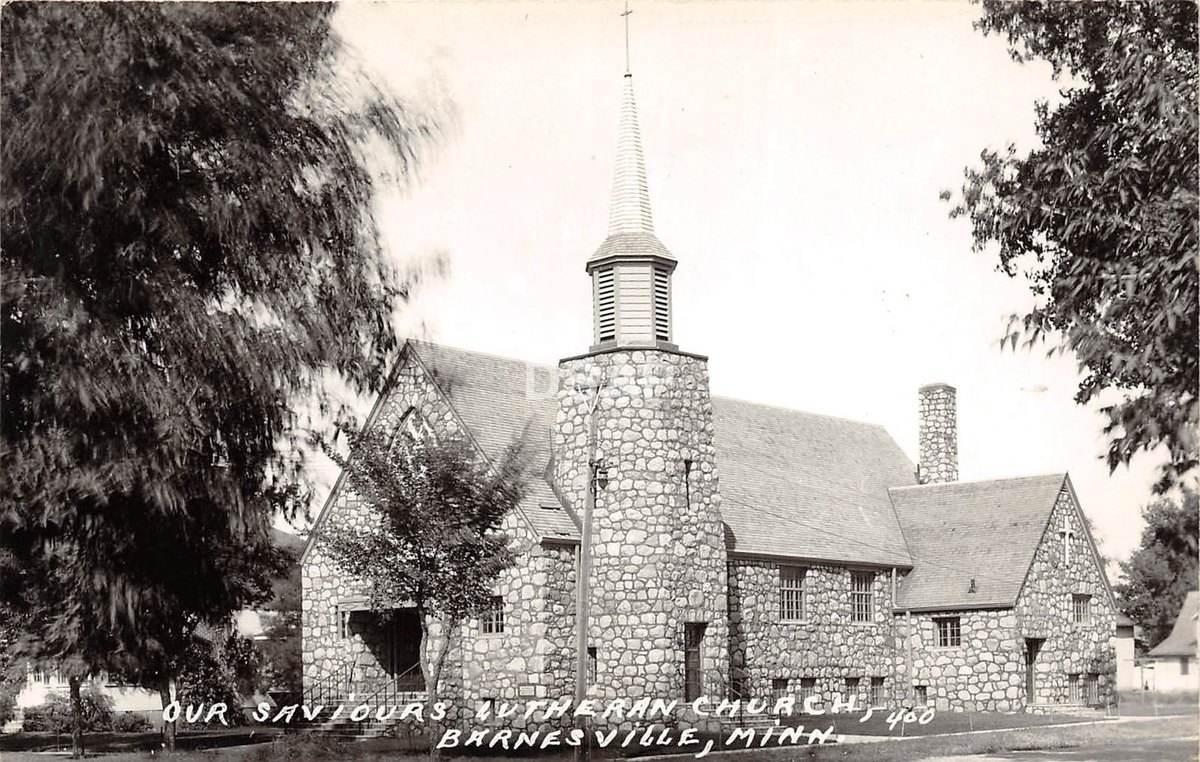
She was confirmed at the Barnesville Lutheran congregation in May of 1927, fifteen years old, in a class of other Danish-American teenagers. Her brother Leslie was confirmed there the spring after. The Lutheran identity from Skeby had reached the third American-born generation and was still holding.
Our Savior’s Lutheran. The Barnesville church where Sylvia was confirmed in 1927.
The 1929 fall
Around 1929 the farm failed, or the family left it, or both. Nobody knows exactly. The late-1920s wheat crisis was hitting the Red River Valley hard at that time. Grain prices falling. Farm debt mounting. Foreclosures across Clay County and the counties around it. The depression that the rest of the country would not see until the 1930s reached Red River Valley farmers in the late 1920s. The Larsens were not the only family it happened to.
By April of 1930, the family was in Minneapolis. They were renting a flat in Ward 5 for thirty dollars a month. Rasmus, forty-two, was a laborer for the City of Minneapolis Street Department. Cora, forty, was at home. Sylvia, eighteen, was a file clerk at a Minneapolis laundry. Leslie, sixteen, was a mechanic’s helper at a garage. Fern was nine. Vera was seven. The household had a radio.
Bill
The Larsen flat had one more person in it that spring. The 1930 census recorded him on the line under the household: William Andrusko, twenty-two, single, Minnesota-born of Rusyn and Bohemian parents, a paying lodger.
He came from a different Minneapolis than the one Sylvia had moved into. He was the fourth of about ten children of John Andrusko Sr., a Rusyn Greek Catholic immigrant from the Carpathian region, and Frances “Frankie” Zelenka, the daughter of Bohemian Roman Catholic immigrants. The Andrusko household was in the Slavic Catholic district of Minneapolis, near Seven Corners on the West Bank of the Mississippi River flats.
Bill spent at least one summer at the Barnesville farm in the 1920s, working for Rasmus as a teenager. Which years, nobody wrote down. By the time he showed up as a lodger in the Minneapolis flat in 1930, he was six years older than Sylvia, and the two of them had probably known each other for some years already.
The break
By the time Bill and Sylvia married in October of 1938, the marriage of Cora and Rasmus was already over. The 1940 census, taken eighteen months after the wedding, found them at two different addresses. Cora was in Minneapolis, Ward 11, head of her own household, taking in day work as a domestic. Vera, the youngest daughter, then seventeen, lived with her and worked as a stenographer at a farm-chemical company. Rasmus was out in Edina, a lodger in someone else’s house, working as a laborer at a nursery. On Cora’s form, her marital status was listed as married. On Rasmus’s, it was listed as single. They had been apart since at least the spring of 1935.
What caused the break is not written down anywhere. The way Ross and Paul told it, passed down from their mother, was that Rasmus left Cora, probably for another woman. They did not know the specifics. What they remembered is that their mother Sylvia, their aunt Vera, and their grandmother Cora all carried a dislike of Rasmus that came from the leaving itself. Sylvia was twenty-four when it happened. She was the oldest child, and she understood directly what her father had done and what it cost her mother. No divorce filing has turned up in either Hennepin or Clay County. What seems to have happened is that Rasmus simply walked out and did not make it legal.
He did eventually remarry. A woman named Ella, born around 1890, last name unknown. Rasmus and Ella lived in a series of Minneapolis rooming houses for the rest of his life. Cora kept herself going, in a series of Minneapolis flats, and by 1950 in the household of her youngest daughter Vera and her husband Jack Pierce out in Minnetonka. From 1935 on, Cora and Rasmus lived apart.
The wedding, October 1938
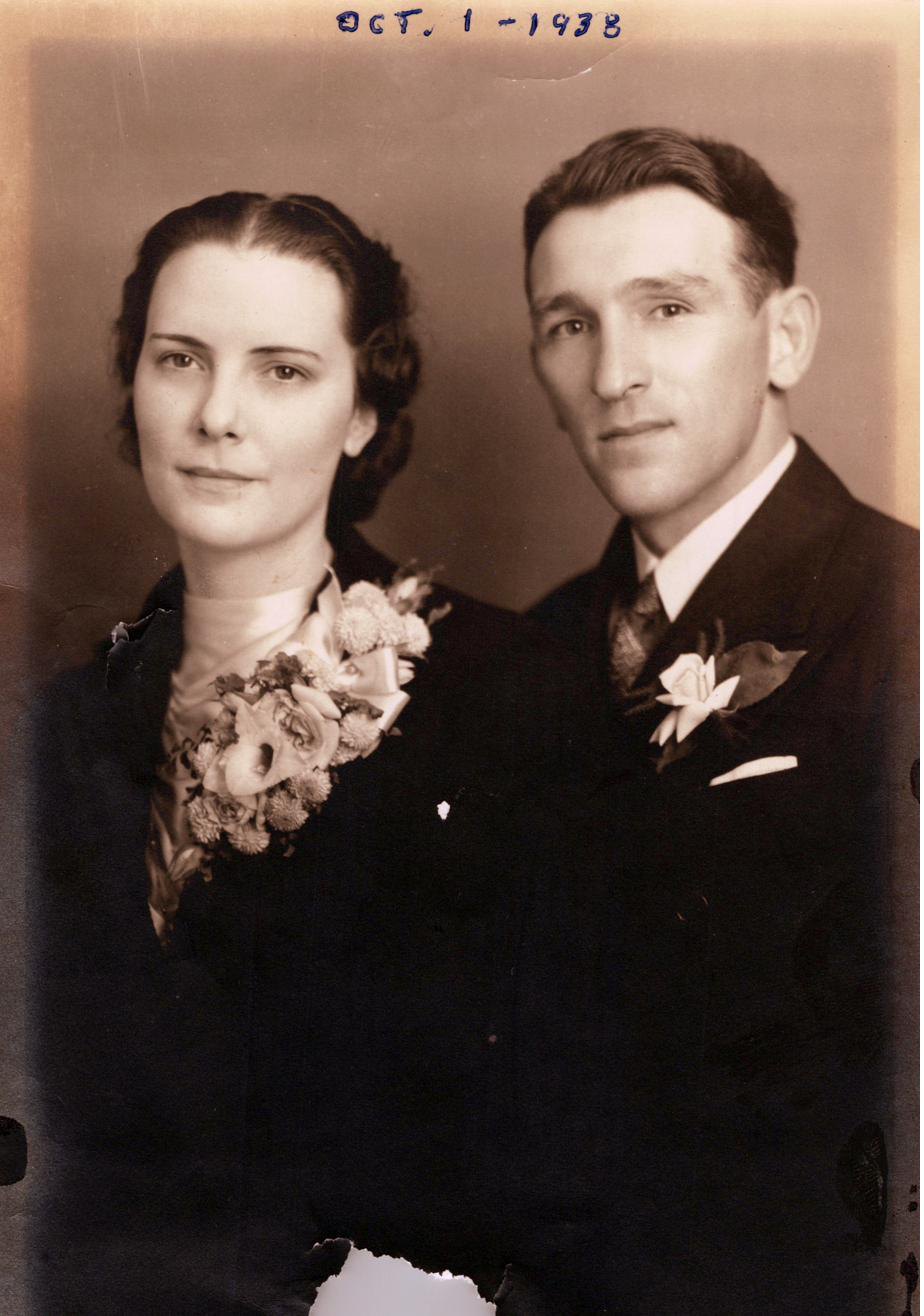
Bill and Sylvia got married on the first of October, 1938, in Hennepin County. He was thirty. She was twenty-seven. The clerk who filled out the marriage certificate wrote his name as Andresko. The mistake stayed on the certificate.
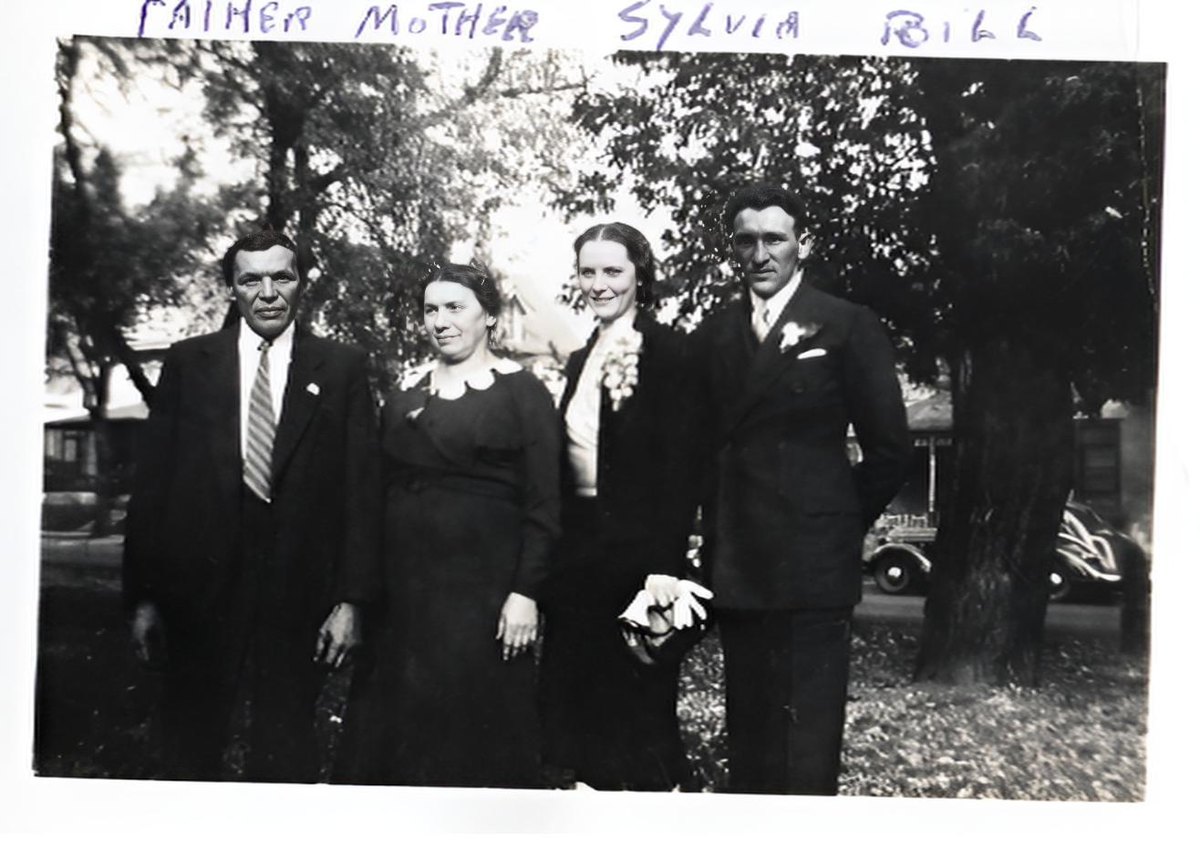
Three photographs survive from the day. The first shows Bill and Sylvia with his parents, John Sr. and Frankie. Bill labeled it years later, in blue ink across the top: FATHER MOTHER SYLVIA BILL. The second shows the couple with her parents, Cora and Rasmus. Bill labeled that one too: CORA SYLVIA BILL RASMUS. A third shows the couple alone. All three are from the same day. The couple is in the same poses and the same clothing across them. Both sets of parents had come. It is the only day in the family record where both halves of Sylvia’s family appear with her. The estrangements on both sides came later, after the wedding, not before.
October 1, 1938. Bill and Sylvia on their wedding day. The date is inked on the print itself.
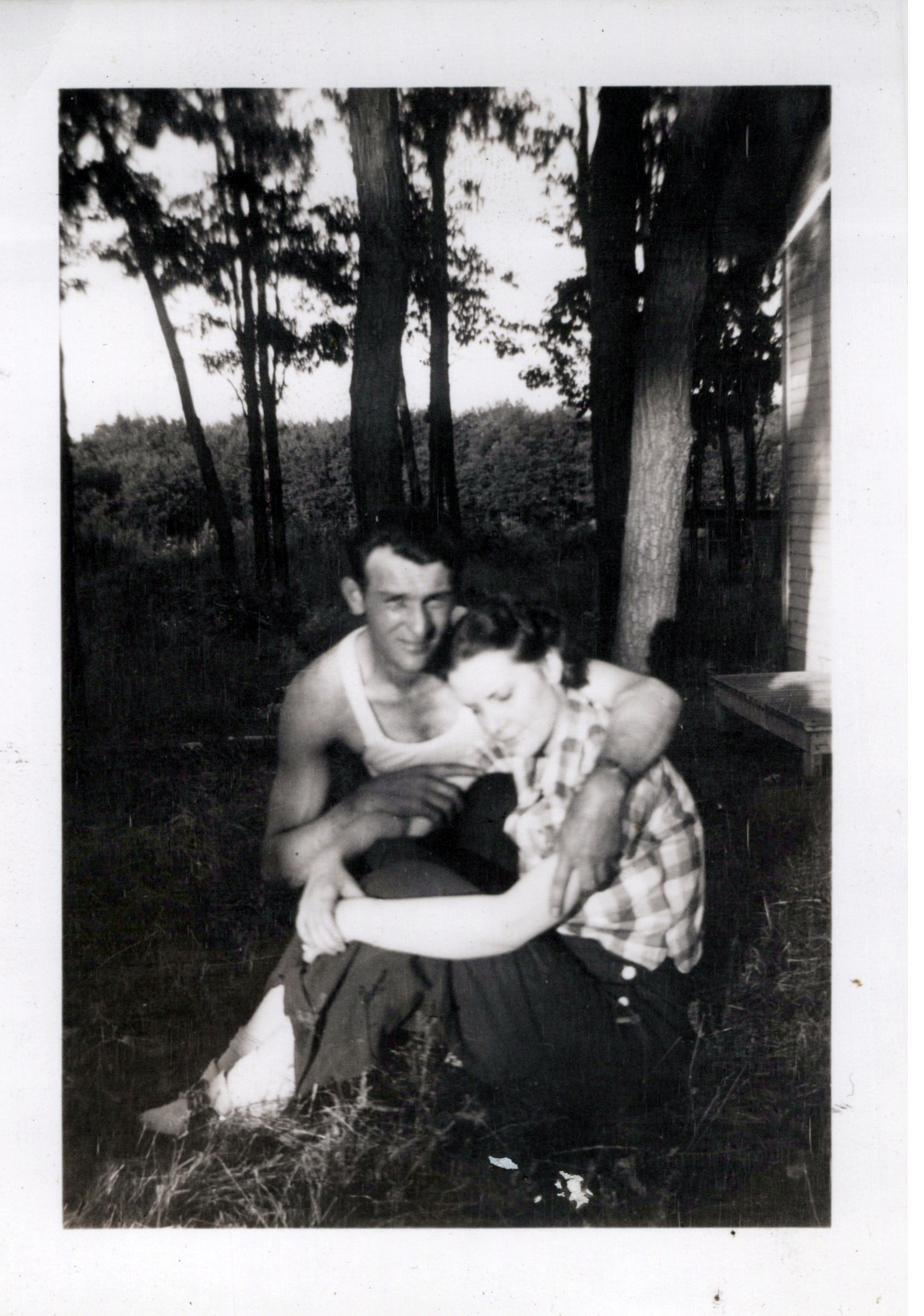
Bill and Sylvia. From their courtship, in the years before the wedding.
The Andrusko estrangement was Sylvia’s, not Bill’s. Paul recalls Sylvia had felt that her in-laws were, in her words, from the wrong side of the tracks. It was a class or family judgment, and she carried it through her marriage. Bill naturally did not share the judgment. He visited Frankie every Christmas for the next three decades, until she died in September of 1969. Sylvia did not go with him.
Ross met his paternal grandmother only a handful of times in his life. Once, during his college years, when he was working a summer job for the city of Minneapolis, he spotted her walking through Seven Corners. He went over to say hello. He had to explain who he was, that he was Willy’s son Ross.
Brookview
Bill and Sylvia’s first married home was at 2929 35th Avenue South in Minneapolis. By 1940 Sylvia was working as a saleswoman at L. S. Donaldson Co., the big department store downtown on Nicollet Avenue. Ross was born in March of 1941. Paul came along in October of 1943.
In 1947 they bought a house at 6304 Brookview Avenue in Edina, then a developing suburb southwest of the city. Ross was six. Paul was four.
The house was on the shore of Lake Cornelia. In those years Lake Cornelia was bigger than it is now, an irregular lake with bays and fingers reaching off in several directions. Years later, when they built Highway 62, the Crosstown cut across the northern end of the lake and severed two of those fingers from the main body. The main body kept the name. The water behind the Brookview house got a new name: Lake Otto.
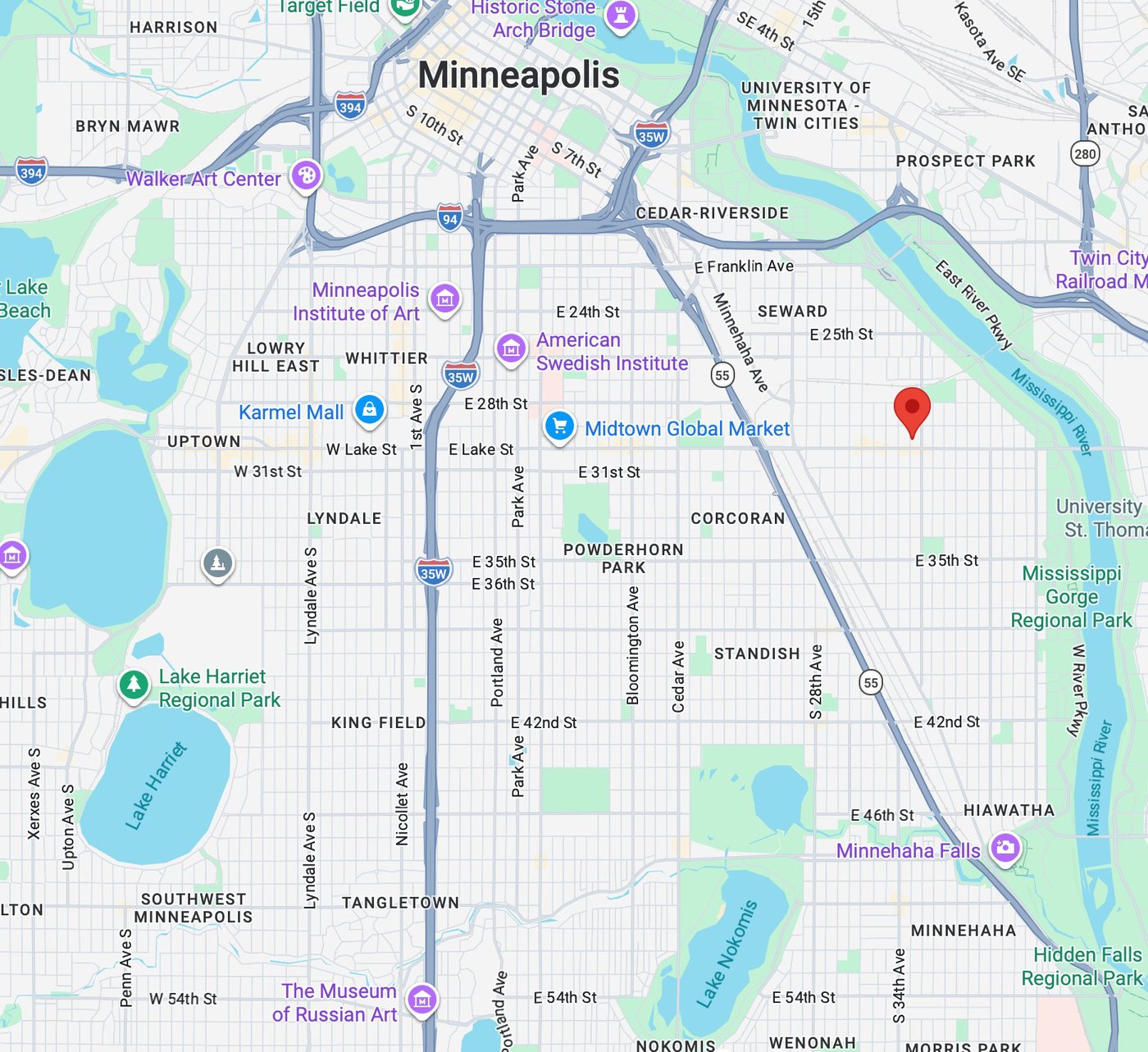
2929 Thirty-fifth Avenue. Bill and Sylvia’s first married home in south Minneapolis.
Bill and Sylvia would own that house for forty-eight years. He worked as a tree trimmer at Northern States Power Company until he retired around 1972. Music and horseshoes filled his off hours, and the house had trophies of his on the shelves. She ran the household, kept the yard, walked the lakeshore, and stayed active at Edina Baptist. They raised Ross and Paul in that house.
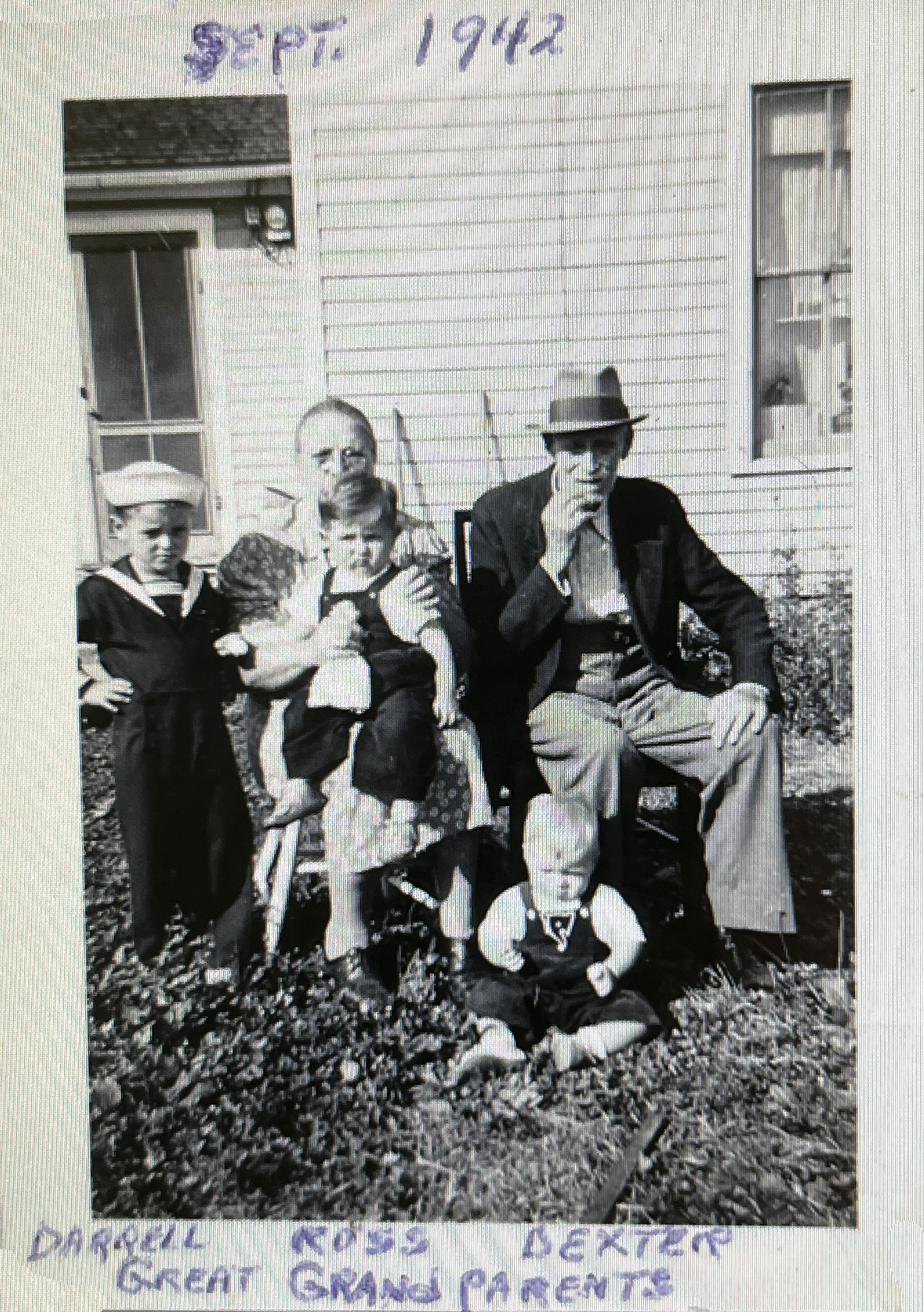
Four generations. Pauline and Nels Madsen in 1942, holding our father’s cousin Ross. Sylvia’s grandmother lived to see the American great-grandchildren.
The twins
In June of 1949, Sylvia gave birth to twin daughters. Their names were Ruth and Rhoda. They were born alive, but they lived only a few hours. Ross had the story of what happened. Sylvia had caught German measles during the pregnancy, and the infection had reached the twins. Sylvia was thirty-eight. Bill was forty-one. Ross was eight. Paul was five.
Bill and Sylvia bought a plot at Lakewood Cemetery in Minneapolis and buried the twins there. The plot would receive five more family members over the next seventy-three years.
The Edina years
Once Ross and Paul were both in school, Sylvia went back to work. The job she chose was close to home: food service at the Edina Schools. She was a lunch lady in the kitchens of the same district her sons attended, at Concord Elementary and South View Middle. The boys went through their school years with their mother behind the lunch counter.
Her religious life shifted in the Edina years too. She had been Danish Lutheran her whole life. The Folkekirken at Skeby was six generations back. In Edina she left the Lutherans and joined Edina Baptist Church, at 53rd Street and France Avenue, a mile north of the Brookview house. Whether the change was a deliberate religious decision or the practical choice of a nearby community church, it held. She was active at Edina Baptist for the rest of her healthy adult life.
She loved being outside. She loved the lake behind the house, and the ducks and the geese on it, and the seasons moving across the yard. She fed the birds. She walked the yard. The farm girl from Alliance Township had moved into a house on water and was at home with it.
Her parents
In December of 1957, Sylvia’s mother Cora died in a Minneapolis hospital, after a month’s illness. She was sixty-seven. Cora’s daughter Fern had come up from Corpus Christi for the last week. Sylvia and Vera were close by. Leslie was up at Ely. Cora was buried at Lakewood, near her twin granddaughters. Her stone reads CORA P. LARSEN 1890 to 1957. No husband. No religious word.
Sometime in those years Rasmus came by the Brookview house. It was the only time Ross and Paul ever met their grandfather. The visit lasted about an hour. Paul remembers two things about it. That it was the only time. And that Rasmus drove a big nice car.
On the first of January, 1965, Rasmus died in Minneapolis. He was seventy-seven. He was buried at Oak Hill Cemetery, in the plot of his second wife Ella. His Oak Hill stone reads HUSBAND RASMUS LARSEN 1888 to 1965.
Rasmus and Cora had been married for twenty-nine years and separated for the next twenty-two. They ended up buried in different cemeteries in the same city. Cora was at Lakewood with the twins. Rasmus stayed at Oak Hill with his second wife.
The grandmother
Marcus has direct memories of Sylvia from when he was small. She traveled out from Edina to Beaver County, Pennsylvania, more than once across the late 1970s to see the family, when Marcus was somewhere between three and five years old. He remembers going on walks with her, and easy hikes. He remembers visiting Brookview and feeding the geese by the lake behind the house. A farm girl, grown old, still drawn to water, birds, walking, and weather.
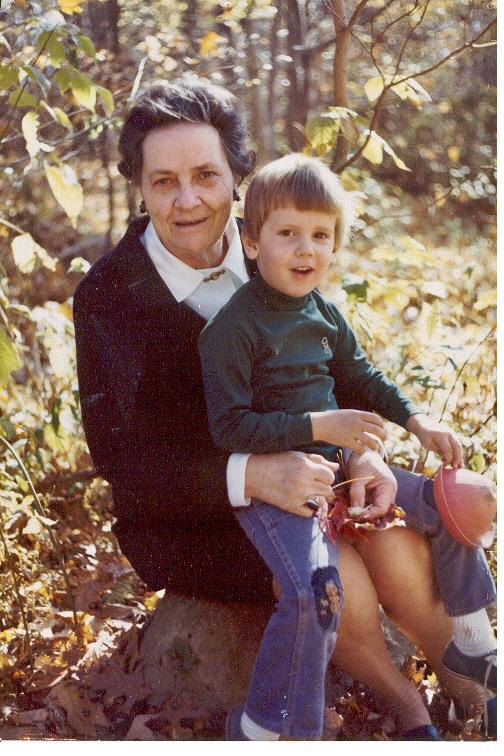
Sylvia and Marcus. Our grandmother with Marcus, the youngest grandchild, in Pennsylvania in the late 1970s.
Sometime in those same years, Sylvia began to show signs of Alzheimer’s disease. Her body lived on much longer than her mind did.
Buffalo
The illness moved through her slowly across the next decade. For the early years of the decline she stayed at home in Edina, and Bill ran the household and took care of her. By the early 1980s, taking care of her at home was no longer possible. She went to a rest home in Buffalo, in Wright County, about thirty-five miles northwest of Edina. Bill visited her regularly. The last few years she could no longer speak. She was fed and cared for, but the person she had been was gone by then. She died at the Buffalo rest home in September of 1986. She was seventy-five.
She was buried at Lakewood, in the plot where her mother Cora had been laid twenty-nine years before, and where her infant daughters had been laid thirty-seven years before. Bill joined them nine years and four months later, in January of 1995.
What carried forward
Bill and Sylvia’s two surviving sons were the third American-born generation of the Larsen-Madsen line, and the second of the Andrusko line.
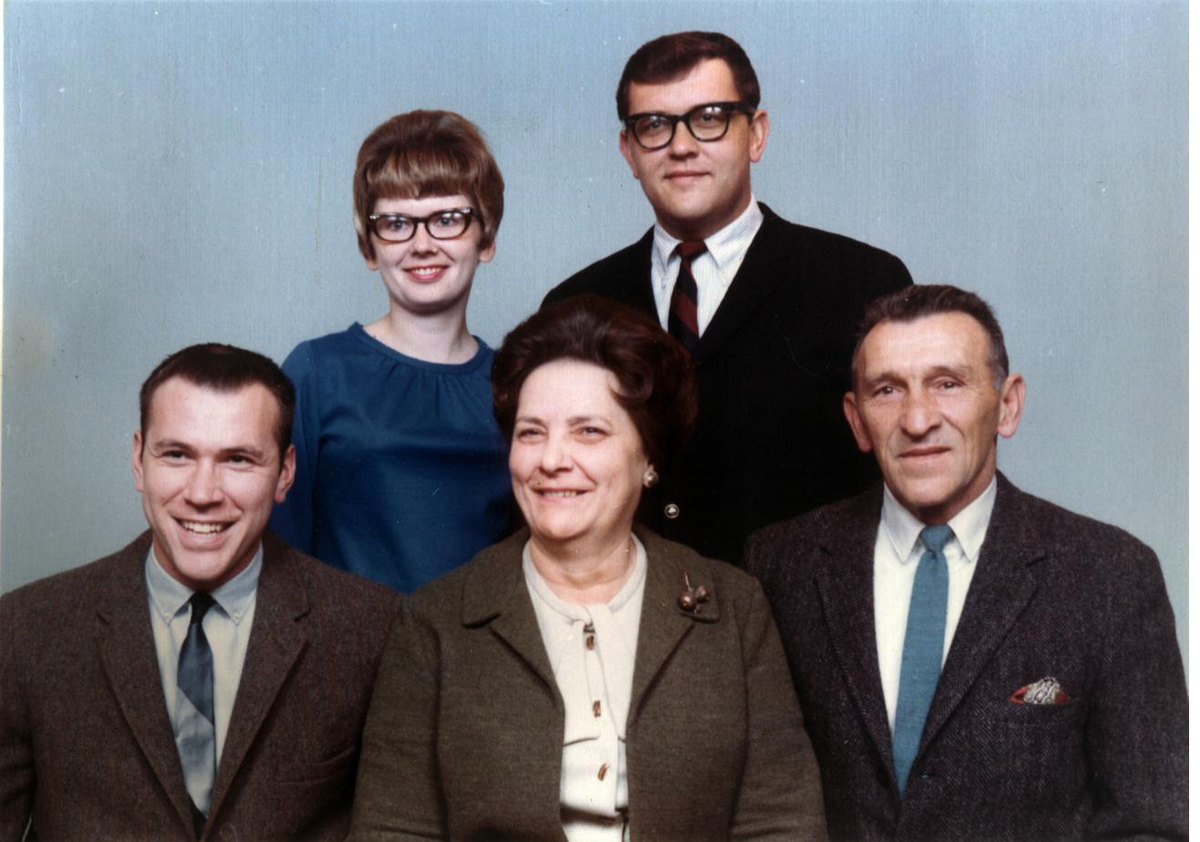
The family that carried on. Bill and Sylvia with Lois and their sons, in a studio portrait from the late 1960s.
Ross met Lois Schave at Northwestern in St. Paul. They married and moved to Beaver Falls, Pennsylvania, where their three children were born. Kent first, then Kerry, then Marcus.
The three grandchildren grew up and had families of their own. Kent and his wife Sandi have three children: Aiden, Raina, and Brennan. Kerry and Kyle had two sons, Kjell and Cam, before that marriage ended. Marcus and his wife Abby have four: Selah, the twins Sage and Havilah, and Elsie.
Marcus’s family lives in the same Brookview neighborhood where Bill and Sylvia raised their boys. All four of his children have gone to Concord Elementary and South View Middle, the same Edina schools where Sylvia worked the lunch counter.
Paul has stayed in the Twin Cities the whole time.
The Lakewood plot
The Lakewood plot now holds seven of them. Ruth and Rhoda first, in 1949. Their grandmother Cora was added in 1957, eight years after them, having never gotten to know them. Their mother Sylvia in 1986. Bill in 1995. Lois, Ross’s wife, in 2007. Ross himself in 2022.